 Reviews



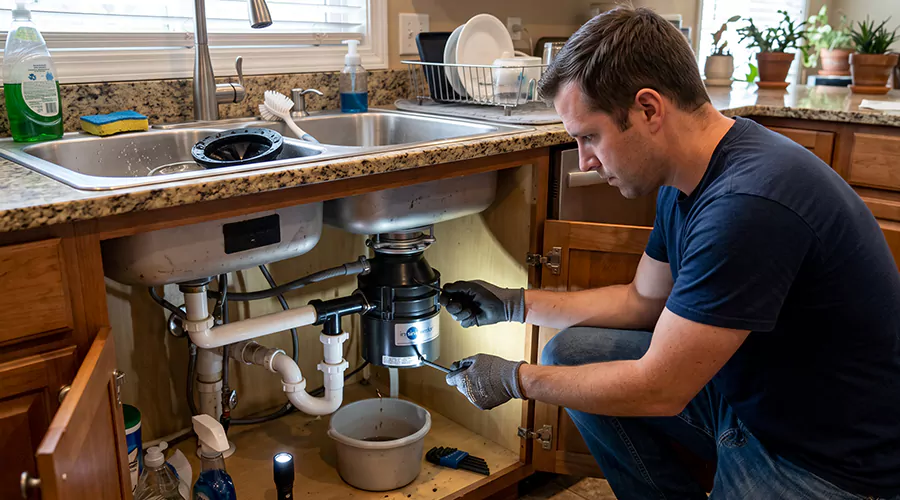
A clogged garbage disposal can result from food blocking the discharge pipe or an object jamming its grinding mechanism. Identifying which problem exists is essential because a working motor cannot clear an obstruction farther down the drain. Garbage disposal repair can diagnose and address mechanical jams, discharge blockages, and other disposal problems affecting normal kitchen drainage.
According to July 2026 U.S. pricing data, professional garbage disposal repair averages approximately $230. However, many simple drainage and reset problems can be investigated without immediately replacing the appliance.
This guide focuses on diagnosing the failure and correcting the underlying problem rather than repeatedly running a disposal that is not working properly.
Why Does a Garbage Disposal Become Clogged?
Garbage disposals can develop two different problems that are often described using the same term.
A mechanical jam occurs when material prevents the grinding mechanism from rotating. A drainage clog develops when material obstructs the discharge opening or connected waste pipe.
Possible causes include:
- Excessive food waste entering the disposal at once.
- Fibrous material becoming tangled around internal components.
- A foreign object preventing normal rotation.
- Food collecting near the discharge outlet.
- Grease accumulating inside the connected drainpipe.
- A blockage inside the kitchen sink P-trap.
- Debris restricting the branch pipe beyond the disposal.
The distinction is important because clearing the connected drain will not repair a seized grinding mechanism.
How Can You Tell Whether the Disposal Is Jammed or Clogged?
The appliance's behavior provides useful diagnostic information.
A disposal that hums without rotating may have a mechanical jam. A disposal that runs normally while water remains in the sink is more likely to have a drainage restriction.
| Symptom | Possible Problem | Initial Investigation |
|---|---|---|
| Motor hums without rotating | Jammed mechanism | Turn off power and inspect |
| Disposal runs but water remains | Drainage blockage | Check the connected drain |
| Unit makes no sound | Power or overload problem | Check power and reset system |
| Water backs into the second sink | Shared drain restriction | Inspect the common waste pipe |
| Disposal repeatedly stops | Jam or motor protection issue | Follow manufacturer instructions |
| Water leaks beneath the appliance | Seal or housing problem | Perform a separate leak inspection |
Manufacturer guidance distinguishes between a jammed appliance, a unit that will not start and a disposal that runs while the sink remains clogged.
What Are the Warning Signs of a Serious Disposal Problem?
A clogged disposal can create symptoms beyond standing water.
Watch for these warning signs:
- The motor produces a humming sound without rotating.
- The appliance shuts off during operation.
- The overload protector repeatedly trips.
- The sink drains slowly despite normal motor operation.
- The second basin fills when water enters the disposal.
- Unusual grinding noises occur.
- The disposal stops shortly after starting.
- Food residue accumulates despite normal use.
- An unpleasant odor returns immediately after cleaning.
- Water begins leaking beneath the appliance.
Persistent electrical or mechanical symptoms deserve more caution than an ordinary food blockage.
What Should You Do Before Attempting Repairs?
Disconnect electrical power before inspecting the garbage disposal. Turning off the wall switch alone is not sufficient protection during hands-on maintenance.
If the appliance has a plug, disconnect it. Otherwise, turn off the appropriate circuit breaker and verify that the unit cannot start.
Prepare the work area with a flashlight, suitable tools and a container for standing water.
Never put your hand inside a garbage disposal.
Moen explicitly instructs users to disconnect power and use tongs or needle-nose pliers rather than placing their hands inside the grinding chamber.
How Do You Fix a Jammed Garbage Disposal?
A jammed unit requires restoring the grinding mechanism's movement before attempting another powered test.
Many models provide a manufacturer-approved manual turning mechanism.
Follow these steps:
- Disconnect the disposal's electrical power.
- Remove standing water if necessary.
- Shine a flashlight into the grinding chamber.
- Look for visible foreign objects.
- Retrieve accessible objects with suitable tongs.
- Locate the manufacturer's manual turning mechanism.
- Use the specified wrench or tool to work the mechanism gently.
- Stop if the mechanism cannot move without excessive force.
- Remove all tools before restoring power.
Many InSinkErator models use a manual wrench socket beneath the disposal. The manufacturer provides specific instructions for using its supplied wrench.
Not every disposal has the same mechanism. Follow the instructions for the installed model.
How Do You Reset a Garbage Disposal?
A disposal may shut itself off when its overload protection activates. This can happen after a jam or prolonged operation.
Resetting should occur only after the underlying problem has been checked.
For models with a manual reset button:
- Switch off the disposal.
- Disconnect power before inspecting the mechanism.
- Confirm that the grinding mechanism is no longer jammed.
- Allow the motor to cool if required.
- Locate the reset button according to the manufacturer's instructions.
- Press the button as directed.
- Remove every tool from the sink opening.
- Restore power.
- Perform a brief operational test.
InSinkErator notes that some models require a cooling period before the overload protector can be reset. Its instructions vary by product design.
Repeatedly resetting a disposal that continues jamming can cause additional damage.
What If the Motor Runs but Water Will Not Drain?
If the disposal rotates normally but the sink remains full, the blockage may be located inside the discharge pipe or connected kitchen drain.
Start with the accessible drainage system.
Check whether a second sink bowl is also affected. If both basins back up, the restriction may sit after their drainage lines join.
A suitable sink plunger can sometimes move a nearby soft obstruction.
If plunging fails, the P-trap and connected drainage piping may require inspection.
Do not attempt to solve a downstream blockage by repeatedly operating the motor.
The manufacturer specifically distinguishes a working disposal with a clogged drain from an appliance with a jammed grinding mechanism.
Can You Use Chemical Drain Cleaner?
Chemical drain cleaners should not be treated as the default solution for a clogged garbage disposal.
Some chemicals can damage components, and trapped liquid creates a hazard during later mechanical work.
Avoid:
- Mixing different drain-opening chemicals.
- Combining drain cleaner with bleach.
- Operating the disposal with unknown chemical liquid present.
- Removing a P-trap containing corrosive cleaning products.
- Inserting tools into the chamber while electrical power is connected.
Follow the appliance manufacturer's cleaning recommendations rather than assuming every household drain product is compatible.
How Much Does Garbage Disposal Repair Cost in 2026?
The cost depends on whether the problem involves an accessible obstruction, a replaceable component or internal appliance damage.
| Repair | 2026 U.S. Cost Reference |
|---|---|
| Simple accessible jam | May be resolved through DIY troubleshooting |
| General professional disposal repair | Approximately $230 average |
| Continuous-feed disposal repair | 80–270 |
| Batch-feed disposal repair | 70–310 |
| Complete disposal replacement | Approximately $550 average |
These figures come from Angi's July and August 2026 national pricing guides. Actual costs vary by appliance and local labor rates.
When Should You Call a Professional?
Professional repair becomes appropriate when safe troubleshooting does not restore normal operation.
Seek assistance when:
- The grinding mechanism cannot be freed.
- The motor repeatedly shuts off.
- The appliance does not start after the prescribed reset procedure.
- An electrical fault is suspected.
- A foreign object cannot be removed safely.
- Water leaks from the appliance's internal housing.
- The disposal remains blocked despite clearing accessible drainage components.
Electrical faults and internal motor repairs should not be handled through improvised DIY procedures.
How Can You Prevent Future Disposal Problems?
Garbage disposal maintenance should focus on controlling the amount and type of food entering the appliance.
Recommended habits include:
- Avoid putting hard objects inside the disposal.
- Keep fibrous material out when the manufacturer advises against it.
- Do not pour grease into the appliance.
- Use an appropriate cold-water flow during grinding.
- Continue running water briefly after grinding finishes.
- Clean accessible components according to manufacturer instructions.
- Stop operation immediately when unusual sounds develop.
InSinkErator recommends cold water during food grinding and warns against introducing grease or fat into the disposal or drain.
Conclusion
To fix a clogged garbage disposal, first determine whether the grinding mechanism is jammed or the connected drain is obstructed.
Disconnect power before inspecting the appliance. Use the manufacturer's approved method to release a jam and reset the overload protection only after the underlying problem has been addressed.
A disposal that rotates normally while the sink remains full needs drainage investigation rather than repeated motor operation.
Frequently Asked Questions
Why does my garbage disposal hum but not work?
The grinding mechanism may be jammed. Disconnect power and follow the manufacturer's unjamming procedure.
Can I reset a garbage disposal while it is jammed?
Remove the obstruction first. Repeated attempts to operate a jammed unit can cause additional problems.
Why does water remain in the sink when the disposal runs?
The discharge pipe or connected kitchen drain may contain a blockage.
Can I put my hand inside the disposal when it is switched off?
No. Disconnect electrical power and use appropriate tools rather than reaching inside.
Does a clogged disposal always require replacement?
No. Many blockages and accessible mechanical jams can be resolved without replacing the appliance.